

Skateboarding might look simple when a person does it, but teaching a humanoid robot to do the same is another story.
RELATED: Shrimpdaddy Has Created The First AI Skateboarder Named “mudderfuger”


Unlike walking on flat ground, skateboarding involves constant motion, shifting balance, rolling wheels, and subtle body adjustments that must work together. For robots, that kind of dynamic coordination is extremely difficult.
Most humanoid control systems are designed with stable environments in mind. Walking across a room or picking up an object from a table is challenging, but the ground usually stays still.
A skateboard changes everything. It rolls, tilts, and turns underneath the robot, which must balance on an unstable platform while also controlling direction.
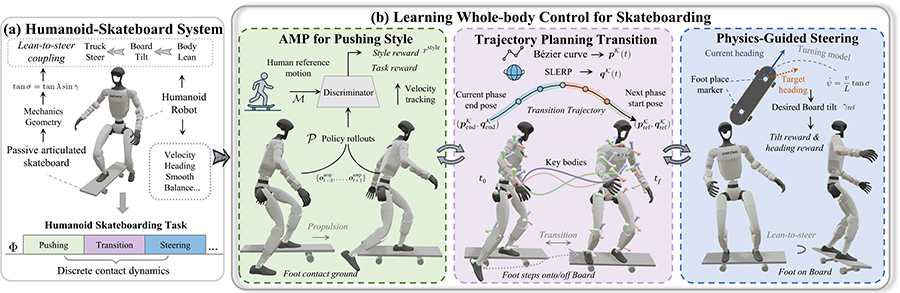
To address this, engineers developed a learning-based framework called HUSKY.
The system models both the humanoid and the skateboard as a single connected system rather than treating them separately. This is important because the robot and board constantly influence each other. A small shift in body weight changes the board’s tilt, which then changes the direction of travel. Everything is tightly coupled.
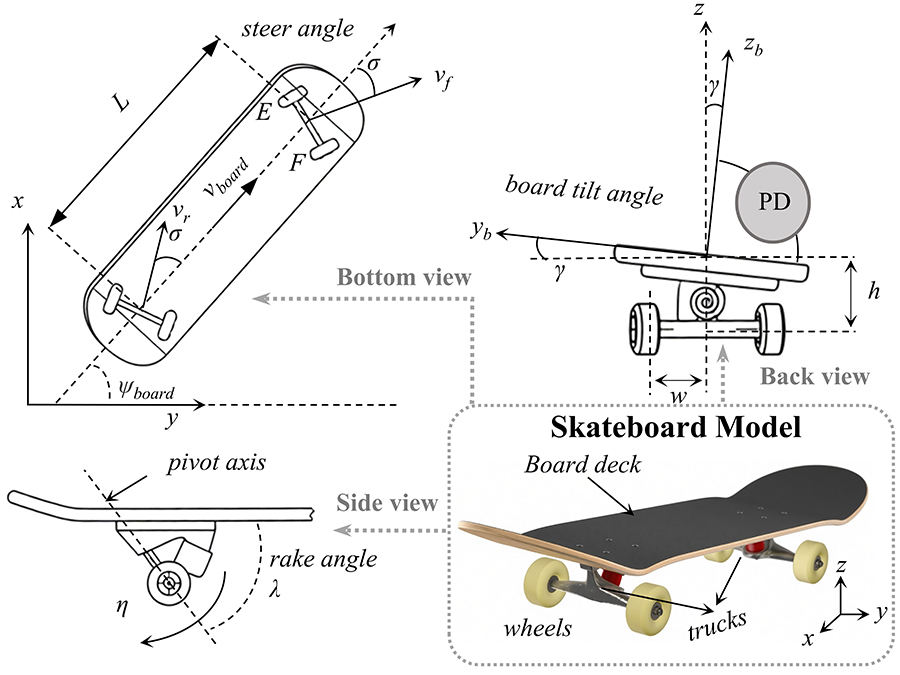
A key part of the work is understanding how the skateboard turns. When a rider leans to one side, the deck tilts, rotating the truck axes due to the board’s geometry.
The relationship between tilt angle and steering angle depends on the rake angle built into the trucks. In simple terms, greater tilt leads to greater steering deflection, causing the board to turn.
By modeling this coupling directly, the engineers gave the robot a clear physical rule to follow instead of relying purely on trial and error.
HUSKY also uses Adversarial Motion Priors to help the robot learn human-like pushing motions. Pushing off the ground with one foot while balancing on the other requires precise coordination.
The system learns these patterns from motion data and refines them in simulation. In addition, a heading-oriented strategy guides how the robot leans to steer. Rather than adjusting posture randomly, the robot learns to lean according to its intended direction.
Another important component is phase transition. Skateboarding is not just standing and turning. The robot must push to gain speed, mount the board with both feet, and then adjust its stance for steering.
HUSKY includes trajectory-guided transitions to ensure these phase changes are smooth and stable, reducing the risk of falls.
Experiments on the Unitree G1 humanoid platform show that the system works beyond simulation. The robot performs stable and smooth skateboarding motions in real-world settings. It can move forward, execute controlled turns, and transition between pushing and steering while maintaining balance.

When researchers removed the equality constraint linking board tilt to truck steering, the robot struggled to turn and mostly glided straight ahead. Without tilt guidance, the achievable heading range was narrow. Restoring tilt guidance enabled smooth turning and a wider range of precise directions.
Training analysis also highlighted the importance of structured transitions. Early in training, episode length increased in both comparison setups, meaning the robot stayed upright longer.

However, without trajectory guidance, it struggled with correct foot-to-board contact patterns and steering rewards remained low. With HUSKY, the robot discovered proper contact patterns by mid-training, learned reliable mounting, and achieved higher rewards overall. The trajectory guidance prevented the system from settling into ineffective movement strategies.
The motion appears coordinated. During transitions, the robot pushes against the ground to generate forward motion, lifts its foot onto the board, and then adjusts its torso perpendicular to the deck to support stable steering.
These movements are gradual and consistent over time, reflecting strong physical modeling and coherent control.
System identification also proved critical. Parameters learned on a compliant board did not transfer well to a stiff board.
In simulation, the robot sometimes relied on small board deformations during mounting. A stiff real-world board did not deform the same way, breaking that assumption.
Conversely, applying stiff-board parameters to a compliant board caused excessive leaning and instability during steering. This highlights how sensitive the control policy is to the physical properties of the platform.

Overall, the project shows that humanoid robots can manage tasks requiring continuous balance, mechanical coupling, and coordinated whole-body motion on rolling platforms.
Teaching a robot to skateboard is more than a novelty. It is a demanding test of dynamic control, contact modeling, and learning-based motion generation. As these systems improve, robots may become far more capable in environments that are constantly moving beneath them.