
Transgender women athletes have officially been excluded from women’s Olympic events, and while most of the headlines are focused on track, swimming, and other big stages, the ripple effect is already being talked about in skateboarding circles too.
RELATED: Skate Legend Henry Sanchez Says Trans Pro Skater Luiza Marchiori Shouldn’t Steal Trophies From Girls

Skateboarding has always had its own lane.
It showed up at the Olympics for the first time at the Tokyo Games and carried that raw street culture into a global spotlight.
Unlike traditional competition formats, skateboarding grew out of local scenes, DIY parks, and communities that made space for people who did not always feel welcome elsewhere.
That includes a growing transgender skate community that has been carving out its place over the past decade.
The new Olympic policy says that eligibility for women’s events will now be limited to biological females, determined through a one time gene test.
RELATED: Transgender Pro Skater Luiza Marchiori Crowned Champion of Brazilian Women’s Skateboarding

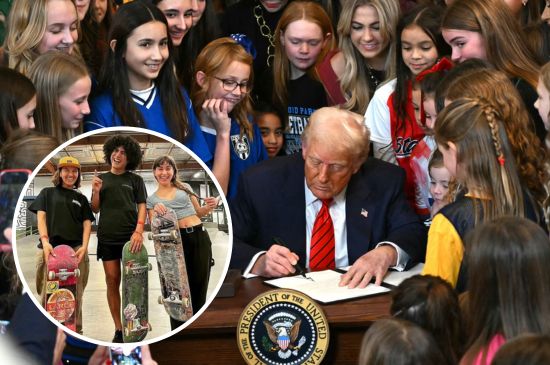
This did not just pop up randomly. It connects to a bigger political shift in the United States, where President Donald Trump has already taken steps to restrict transgender women from competing in women’s categories.
Earlier this year, he signed an executive order focused on keeping transgender women out of women’s categories. From there, it started trickling into major organizations, and now it is showing up at the Olympic level.
READ MORE: President Trump Signs Executive Order Banning Transgenders From Women’s Sports
For skateboarding, the situation is a bit complicated. On one hand, Olympic skateboarding falls under the same rules as every other Olympic discipline.
On the other hand, the culture of skating has never been fully controlled by official organizations. Street contests, independent tours, and local crews still shape what skateboarding looks like day to day.
That is why many skaters are looking at this less as a single rule change and more as a split between two worlds.
The Olympic path is structured, regulated, and now more restricted. The street and community side remains more open, where identity is often accepted without paperwork or testing.
There are not many openly transgender women competing at the highest Olympic level in skateboarding right now. But that does not mean the impact is small.

Representation matters a lot in skating, especially for younger skaters who look to contests and videos to see where they fit in. When a door closes at the top level, it can send a message down the line, even if unintentionally.
At the same time, many in the skate community are pointing out that skating has never depended on Olympic validation.
Brands, video parts, and street credibility often carry more weight than medals. A skater’s name gets known through clips, style, and consistency, not just podium finishes.
That independent spirit is likely where transgender skaters will continue to thrive. Crews, collectives, and inclusive skate groups have already been building their own spaces, hosting events, and supporting each other outside traditional systems. Those scenes are not going away.
RELATED: Christian Pro Skater Felix Arguelles Calls for New Olympic Category for Transgender Athletes

Still, this Olympic call just threw more heat into the conversation. It raises questions about who gets access to global platforms and how governing bodies define fairness.
For now, skateboarding sits in an interesting spot. It is part of the Olympics, but it is not defined by it. And while the new policy sets limits at that level, the streets, parks, and local scenes will continue to shape what the culture looks like moving forward.